
Summary
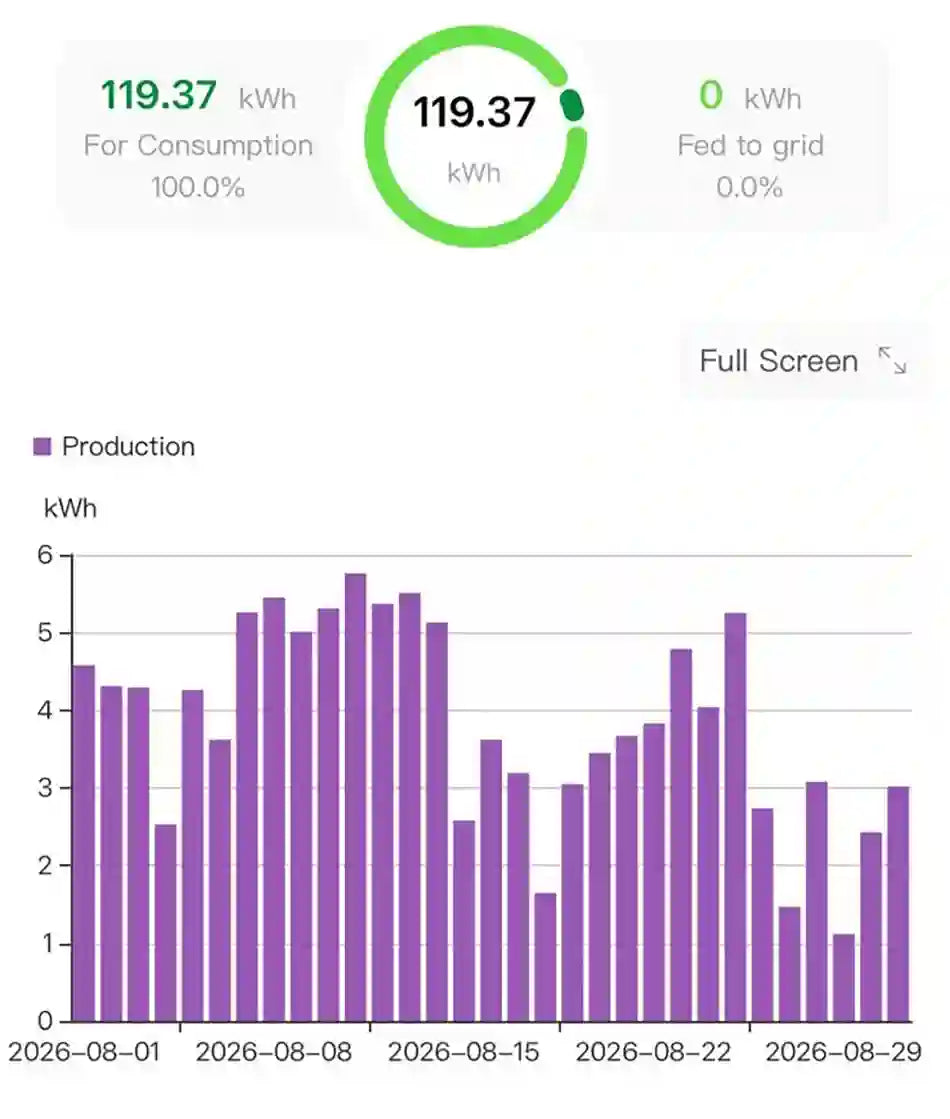
An 800W Plug & Play solar system installed in a suitable UK location can potentially produce around 600–900 kWh of electricity during a typical year. This is a broad planning range rather than a guaranteed output, because actual production depends on location, panel capacity, orientation, angle, shading, weather and system losses.
The term “800W system” normally refers to the maximum AC output of the microinverter. The solar panels themselves can have a higher combined DC rating. For example, two 500W panels provide 1,000Wp of solar-panel capacity while an 800W microinverter limits maximum AC output to approximately 800W.
Having more panel capacity than inverter capacity is not necessarily wasteful. Solar modules only reach their laboratory-rated peak under favourable conditions. Larger panels can therefore help an 800W inverter produce more useful electricity during weaker sunshine, cloudy periods, mornings and afternoons.
Financial benefit depends heavily on self-consumption. Electricity generated while refrigerators, computers, televisions, routers, pumps and other household equipment are operating can directly reduce grid imports.
🌱 Full Length Article (Click to collapse)
How Much Electricity Can an 800W Plug & Play Solar System Generate in the UK?
1. Start with the Difference Between Watts and Kilowatt-Hours
Understanding solar output begins with two measurements that are easily confused: watts and kilowatt-hours.
Watts (W) measure power at a particular moment. An 800W microinverter is therefore capable of producing up to approximately 800 watts of AC output when sufficient solar energy is available.
Kilowatt-hours (kWh) measure the total quantity of electricity produced or consumed over time. This is the unit shown on household electricity bills and is therefore the more useful measurement when estimating annual savings.
2. How Much Could an 800W System Generate Per Year?
There is no universal annual figure because two identical solar systems can produce different amounts of electricity when installed on different properties.
As a broad UK planning estimate, an effectively positioned 800W Plug & Play system might generate approximately 600–900 kWh annually.
A system in southern England with good exposure and minimal shade may sit towards the higher part of that range, whereas a shaded or unfavourably orientated installation could produce substantially less.
The important point is that annual generation is cumulative. Even when the system is producing only 150W, 300W or 500W, those smaller amounts continue adding to the year's total.
3. Solar Generation Changes Throughout the Day
Solar production normally follows daylight. Output begins relatively low, rises as solar irradiance improves, reaches its strongest period around the brighter part of the day and falls again towards evening.
A clear summer day might produce a broad curve with several hours of strong generation. A cloudy winter day might instead show repeated small peaks as cloud conditions change.
4. Summer and Winter Are Very Different
UK solar generation is highly seasonal. Long summer days provide many more hours of usable sunlight than short winter days.
May, June and July can therefore contribute a large proportion of annual generation. December and January normally contribute much less.
5. Why the Solar Panels Can Be Larger Than 800W
An 800W microinverter does not necessarily require exactly 800Wp of solar panels.
Imagine a system using two 500W solar modules. Together, the panels have a theoretical peak DC capacity of 1,000Wp. The microinverter can nevertheless restrict maximum AC output to 800W.
6. Why Oversizing Can Help in the UK
Connecting more than 800Wp of panel capacity to an 800W inverter may initially sound inefficient, because output is capped when the panels could theoretically produce more.
In reality, panels spend comparatively little time operating at their laboratory-rated maximum.
A larger panel array can reach useful inverter output earlier in the morning, remain productive later in the afternoon and perform better during less intense sunshine.
There may occasionally be periods when the available panel power exceeds the inverter's maximum output. The inverter then limits, or “clips”, the excess. Losing a small amount during exceptionally favourable conditions can be outweighed by increased generation during the many hours when sunlight is weaker.
7. Does South-Facing Always Produce the Most?
In the UK, south-facing panels with an appropriate tilt are generally favourable for annual energy production. However, Plug & Play systems offer much greater flexibility than traditional rooftop arrays.
8. Garden Installations Can Work Very Well
Plug & Play solar is not restricted to roofs. Gardens can provide excellent locations where panels receive unobstructed sunlight.
A ballasted mounting system can position panels at a useful angle on patios, concrete areas or other suitable flat surfaces. Because ballast provides the stabilising weight, the installation may avoid permanently drilling into the surface.
Ground-level positioning can also make panels easier to inspect and clean than roof-mounted systems. However, the mounting structure must still be appropriate for the installation and capable of resisting wind forces.
The advantage of a garden installation is flexibility. Where practical, the panels can be placed where solar exposure is better rather than being dictated entirely by the direction of the house roof.
9. What About Wall and Fence Installations?
Walls and suitable fences can provide additional solar-generating space, particularly where roof or garden areas are limited.
Vertical installations behave differently from tilted panels. They generally receive less direct summer sunshine but can perform relatively well when the sun is lower during spring, autumn and winter.
A west-facing wall could also produce electricity later in the afternoon, potentially matching household demand when people return home.
10. Shading Can Make a Significant Difference
Shade is one of the most important factors when deciding where to position solar panels.
Trees, neighbouring buildings, sheds, chimneys and even sections of fencing can reduce solar production. Shadows also move throughout the day and throughout the year.
A garden location that appears completely sunny at midday may experience substantial morning or afternoon shade.
11. How Much Can an 800W System Generate Per Day?
Daily generation varies so much that an annual average can sometimes be misleading.
| Conditions | Possible Daily Generation | What to Expect |
|---|---|---|
| Dark winter day | Below 1 kWh | Short daylight and heavy cloud can substantially reduce output. |
| Bright winter or autumn day | Approximately 1–2 kWh | Useful daytime generation despite shorter days. |
| Typical spring or summer day | Approximately 2–4 kWh | Longer daylight provides extended generation. |
| Excellent summer day | Potentially 4 kWh or more | A well-positioned system can generate strongly for many hours. |
These figures are illustrative rather than guaranteed. The same system might have an excellent day followed immediately by a heavily overcast day producing much less.
12. What Can 800W of Solar Power in a Home?
One useful way to understand an 800W system is to compare its output with common household loads.
13. Why Self-Consumption Matters
Generating electricity is only part of the calculation. The greatest direct saving normally occurs when the household uses the solar electricity while it is being produced.
Suppose your home is consuming 600W and the solar system is generating 500W. Most of that immediate demand can be supplied by the solar system, leaving only around 100W to be imported from the grid.
If the house is using only 100W while solar generation is 600W, there is considerably more surplus electricity.
For this reason, homeowners can sometimes improve the economics of solar simply by moving flexible electricity consumption into daylight hours.
14. Can You Change When You Use Electricity?
Some household tasks can be shifted into solar-generating periods.
Depending on the appliance, users might choose to run a dishwasher, washing machine, dehumidifier, garden equipment or other electrical load during daylight rather than late at night.
Smart plugs and timer functions can make this easier, although appliance safety instructions should always be followed.
15. What Could the Generated Electricity Be Worth?
The value depends on your electricity tariff and how much generation you use directly.
Consider an illustrative system producing 750 kWh during a year. If 80% were used within the home, that would represent 600 kWh of electricity that might otherwise have been purchased from the grid.
16. Why Small Plug & Play Systems Can Pay Back Relatively Quickly
One attraction of Plug & Play solar is that the initial investment can be considerably lower than for a full professionally installed rooftop solar array.
A large rooftop installation can provide far more electricity, but it also involves a substantially greater upfront cost.
A smaller system uses fewer panels, a compact microinverter and a comparatively simple mounting arrangement. If a significant proportion of the electricity generated is consumed within the home, the annual saving can represent a meaningful percentage of the original purchase price.
Depending on system cost, electricity prices, installation conditions and generation, some small systems may potentially recover their purchase cost within only a few years. However, a fixed three-year payback should never be promised because each household's circumstances differ.
17. What Factors Have the Greatest Effect on Generation?
For the best practical performance, consider:
- Geographical location within the UK
- Solar-panel wattage
- Compatibility between the panels and microinverter
- Panel orientation
- Mounting angle
- Morning and afternoon shading
- Seasonal changes in sunlight
- Panel cleanliness
- Microinverter efficiency
- System cabling and other electrical losses
- How much electricity the household uses during daylight
18. Should You Expect the Same Generation Every Year?
No. Annual weather varies, so one year may be noticeably sunnier than another.
Solar panels also gradually lose a small amount of output as they age, although quality modules are normally designed to remain productive for decades.
For financial planning, it is therefore sensible to use realistic long-term assumptions rather than basing expectations on one exceptionally sunny month.
19. Is an 800W System Large Enough to Make a Difference?
Yes, particularly for households with continuous daytime electricity consumption.
An 800W system will not power every electrical appliance in a modern house simultaneously. High-power devices such as electric showers, ovens, immersion heaters and kettles can individually consume several times the output of the solar system.
But that is not necessarily its purpose.
Small solar works particularly well by continuously reducing the background amount of electricity that needs to be purchased from the grid.
Hundreds of watts supplied for many hours, repeated across hundreds of days, can become hundreds of kilowatt-hours over the course of a year.
20. A Practical Example
Imagine a household installs two compatible 500W solar panels connected to an 800W Plug & Play microinverter.
The panels are mounted in an open garden with good exposure and limited shading. During ideal conditions, the combined panels could potentially supply more DC power than the inverter can convert, so the AC output is capped at approximately 800W.
During most of the year, however, the panels are operating below their theoretical maximum. Their additional capacity helps maintain useful production during less-than-perfect conditions.
If the system generates around 750–850 kWh over the year and the household uses most of that electricity directly, it could make a noticeable reduction to annual grid electricity consumption.
Conclusion
An 800W Plug & Play solar system can generate a surprisingly useful amount of electricity in the UK. While the inverter's maximum instantaneous AC output is approximately 800W, the system accumulates energy hour by hour throughout the year.
A broadly favourable installation might generate somewhere around 600–900 kWh annually, but there is no universal figure. Geography, orientation, angle, panel size, shading and weather can all significantly affect production.
Connecting more than 800Wp of compatible solar-panel capacity can also make sense. Two 500W panels, for example, can provide 1,000Wp of DC capacity while an 800W microinverter controls maximum AC output. The extra panel capacity can improve production during the many hours when UK sunlight is below ideal levels.
Garden installations using secure ballasted mounting systems can offer particularly useful flexibility because the panels may be positioned where sunlight is favourable. Suitable walls, fences and other structures can provide additional opportunities where conventional rooftop solar is impractical.
Ultimately, the value of the system depends not only on how many kilowatt-hours it produces but also on how effectively those kilowatt-hours are used. Matching household electricity consumption to daylight generation can increase self-consumption and reduce reliance on electricity purchased from the grid.
An 800W Plug & Play system is therefore best viewed not as a miniature replacement for a large rooftop solar array, but as an affordable way to reduce everyday grid consumption and begin generating renewable electricity at home.
Explore Plug & Play Solar with Worldwide Solar
Worldwide Solar supplies products for compact home solar installations, including Plug & Play microinverters and mounting solutions for gardens, walls, fences and other suitable locations.
Visit Worldwide Solar to explore practical solar solutions designed to make small-scale renewable electricity generation more accessible to UK households.