
Summary
A good UK Plug & Play solar system should be selected as a complete system rather than simply by choosing the cheapest microinverter and two solar panels.
Start with where the panels will actually be installed. A British home may be better suited to a garden ballast system, wall mounting, mesh-fence mounting or a suitable flat roof than to anything resembling a continental European balcony installation.
Next, check the microinverter carefully. Its maximum AC output, MPPT arrangement, voltage range and current limits must be compatible with the solar panels.
For a UK Plug & Play product, also check that the system and its generating equipment meet the applicable UK requirements. Do not assume that a microinverter approved or widely sold elsewhere in Europe automatically qualifies for Plug & Play use in Great Britain.
Finally, consider the complete package: UK cable and plug, mounting system, panel dimensions, monitoring, warranty, documentation and support from the seller.
🌱 Full Length Article (Click to collapse)
How to Choose a Plug & Play Solar System: A Buyer's Guide
1. Understand Where Plug & Play Solar Came From
Modern Plug & Play solar developed particularly strongly in continental Europe.
Germany became closely associated with the concept through the Balkonkraftwerk—literally a “balcony power station”. These compact systems allowed apartment residents and homeowners to generate their own electricity using one or a few solar panels and a small inverter.
The name stuck because balconies provided an obvious mounting location for people without their own roofs.
But even in Germany, these systems are no longer limited to balconies. They are installed on terraces, façades, gardens, fences, garages, carports and roofs.
This distinction becomes even more important in Britain.
2. Britain Needs a Different Plug & Play Solar Mindset
The British housing landscape is different from that of many continental European cities.
Large numbers of UK households live in terraced, semi-detached and detached houses with private gardens, patios, garages and boundary fences.
These spaces create opportunities that the term “balcony solar” does not adequately describe.
3. Start by Deciding Where Your Panels Will Go
Do not buy the solar panels first and worry about mounting them afterwards.
Decide where the system will be installed, assess the available space and then select panels and mounting equipment that suit that location.
4. Garden Solar Can Be Particularly Suitable for Britain
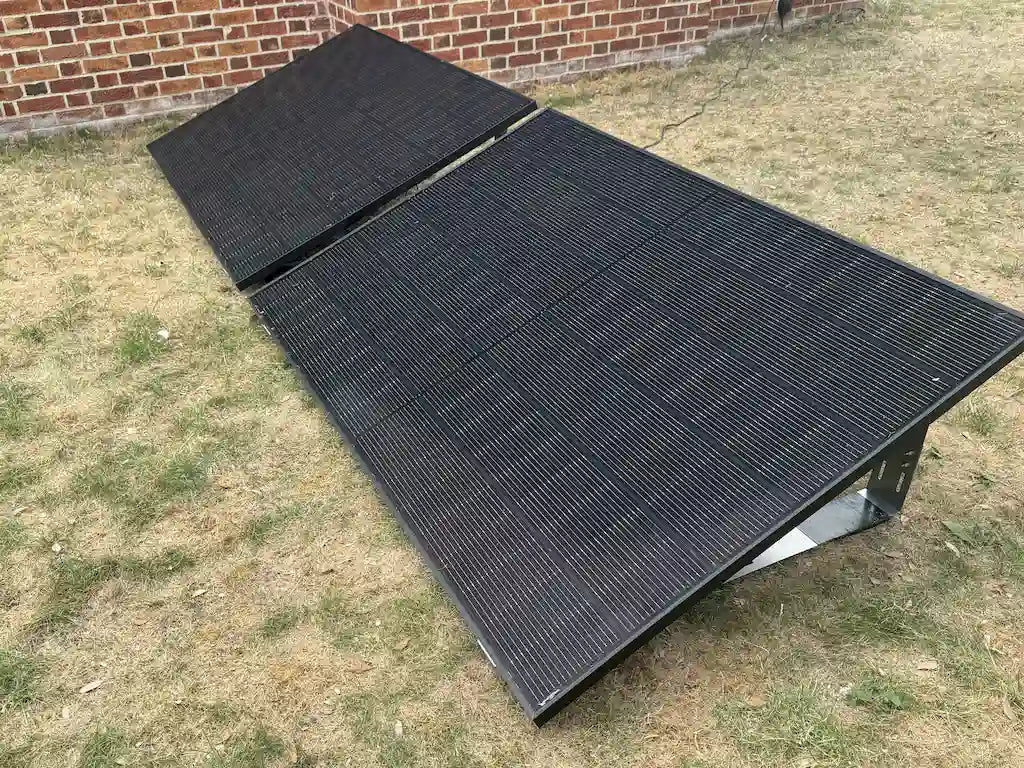
Gardens may become one of the most natural homes for Plug & Play solar in the UK.
A ballasted mounting system can potentially position panels on a patio, paved area or other suitable surface without requiring a conventional rooftop installation.
Garden mounting also gives homeowners freedom to choose a sunny location rather than accepting the orientation of the house roof.
Ground-level panels are relatively easy to inspect and clean, although they must still be mounted securely against wind forces and positioned where they will not be damaged during normal garden use.
5. Walls Can Turn Unused Space into Solar Space
A suitable house, garage or outbuilding wall can provide an alternative when garden space is limited.
South-facing walls can provide useful generation, while east- and west-facing walls can shift production towards morning or afternoon.
Vertical solar may produce less during ideal summer conditions than optimally tilted panels, but it can make use of an area that would otherwise generate nothing.
6. Mesh Fences Can Be Useful Solar Locations
Strong mesh fencing can potentially provide another practical mounting location.
Fence-mounted panels do not consume valuable patio or garden-floor space and can be relatively easy to access.
However, the fence must be structurally suitable. Solar panels create substantial wind loads, so lightweight or unstable fencing should never be used simply because a bracket can physically be attached to it.
7. Flat Roofs Offer Excellent Flexibility
Flat-roofed garages and extensions can be particularly attractive for compact solar systems.
Unlike a pitched roof, a flat roof does not necessarily determine the direction of the panels. A suitable mounting system can potentially orientate them towards a favourable direction and introduce a useful tilt.
Buyers should consider roof load capacity, ballast, wind forces, waterproofing and drainage before choosing this option.
8. What Should Be Included in a Plug & Play Solar System?
At its simplest, a Plug & Play system needs compatible components that work together.