
Summary
Plug & Play solar can be suitable for most UK homes where there is an appropriate electrical installation and a suitable location for the solar panels. A typical system uses one or two photovoltaic panels and a microinverter. The panels generate direct-current (DC) electricity and the microinverter converts it into alternating current (AC) that can contribute to the electricity being used within the home.
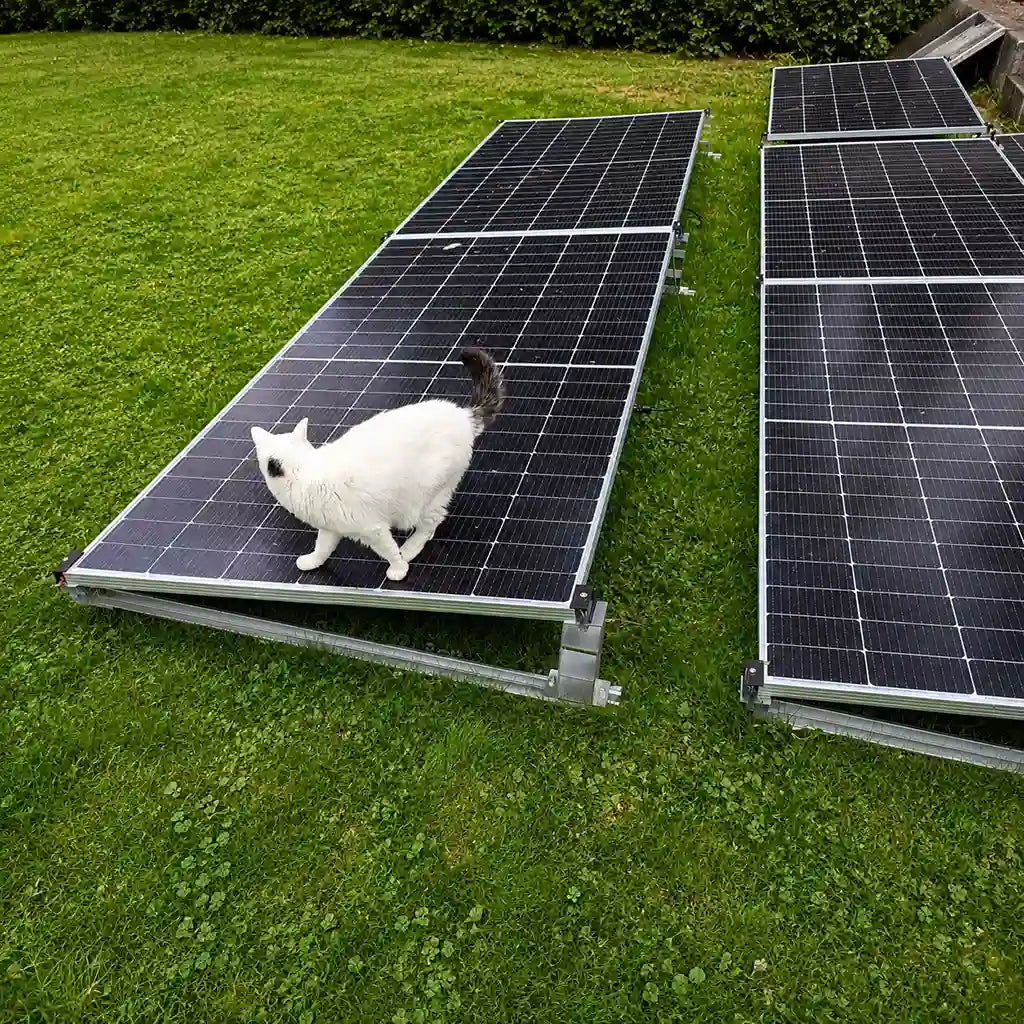
Unlike a large rooftop solar installation, a small Plug & Play system can often be positioned in a wider range of locations. Suitable flat roofs, exterior walls, garages, sheds, fences, patios and garden areas can all potentially be used. Ballasted mounting systems can provide additional options where drilling into the underlying surface is undesirable.
One of the main attractions is cost. A compact system requires far fewer components than a large rooftop array and can therefore involve a much lower initial investment. If the generated electricity is used within the home during daylight hours, it can reduce the amount of electricity purchased from the grid and potentially recover the initial cost of the system over time.
Homeowners should still check that their electrical installation is suitable. In many modern or well-maintained homes this may be relatively straightforward, while older or unusual electrical installations may require further assessment or improvements before solar generation is connected.
🌱 Full Length Article (Click to collapse)
Plug & Play Solar in the UK: A Complete Guide for Homeowners
Introduction: A Smaller and More Accessible Way to Go Solar
Solar power has become an increasingly familiar sight across the UK. Traditionally, however, domestic solar has usually meant installing a sizeable array of photovoltaic panels permanently on the roof of a house.
That can be an excellent investment, but it is not the only option. A full rooftop system can involve a considerable upfront cost, a large installation area and more extensive electrical and structural work than some households want or need.
Plug & Play solar offers a smaller alternative. Instead of covering a substantial part of the roof with panels, homeowners can potentially begin with one or two solar panels connected to a compact microinverter.
For most homes with a suitable electrical installation and enough unshaded space for the panels, this can provide a practical way to start generating renewable electricity.
1. What Exactly Is Plug & Play Solar?
A Plug & Play solar system is a compact photovoltaic installation intended to make small-scale solar generation easier and more accessible.
Solar panels generate electricity in the form of direct current, or DC. A microinverter then converts this electricity into alternating current, or AC, which is the form of electricity used by normal household appliances.
While the solar panels are generating, their electricity can help supply appliances operating within the home. The electricity grid remains available and automatically supplies additional power whenever household demand exceeds solar production.
This means a small system does not need to generate enough electricity for the entire home. Its purpose can simply be to reduce the amount of electricity that needs to be purchased from the grid.
2. Is Plug & Play Solar Suitable for Most UK Homes?
Yes, it can be suitable for most homes provided that two basic requirements can be met: the property has an appropriate electrical installation and there is a suitable location for the solar panels.
The advantage of a small system is that neither requirement is necessarily difficult to achieve. Only a relatively small area is needed for one or two panels, and many homes already have electrical installations that may be suitable once the relevant checks have been made.
A newer home with modern wiring may be relatively straightforward. An older property may also be perfectly suitable, but it makes sense to check the condition of the wiring and protective devices before connecting generating equipment.
In other words, the electrical check should be seen as a sensible part of preparing for solar rather than as evidence that Plug & Play solar is only suitable for a small number of homes.
3. Why Should the Electrical Installation Be Checked?
Solar generation differs from an ordinary household appliance. A television, kettle or washing machine only consumes electricity. Solar equipment can introduce generated electricity into the home's electrical installation.
This means the condition of the wiring, protective devices and connection arrangement matters.
For a modern or well-maintained electrical installation, this does not necessarily mean that substantial electrical work will be required. It simply means the installation should be suitable for the generating equipment being connected.
Older properties, or homes where electrical circuits have been altered repeatedly over many years, may benefit from a more detailed assessment before solar equipment is added.
4. Why Is the Microinverter So Important?
The microinverter is at the heart of a small Plug & Play solar system.
Solar panels naturally generate DC electricity. The microinverter converts this into AC electricity so that it can contribute to household demand.
Many modern microinverters also include one or more Maximum Power Point Trackers, usually known as MPPTs. These continually adjust the operating conditions of the panels to obtain useful power under changing sunlight conditions.
A microinverter with two independent MPPT inputs can be particularly useful with two panels. If one panel becomes partially shaded while the other remains in good sunlight, each input can respond independently.
5. How Much Space Does a Small Solar System Need?
Considerably less than a traditional rooftop array.
This is one of the biggest advantages of Plug & Play solar. Instead of finding enough roof space for perhaps eight, ten or more panels, a homeowner may only need a suitable location for one or two.
Modern high-output photovoltaic panels are still physically large, so panel dimensions should always be checked before ordering. However, a two-panel installation opens up many more location possibilities around the average property.
6. Where Can Plug & Play Solar Be Installed?
Solar panels do not necessarily need to be installed on the main house roof.
In fact, one of the most attractive features of compact solar generation is the ability to make use of otherwise unused areas around a home.
7. Why Gardens Are Particularly Interesting
Gardens can provide excellent opportunities for small solar installations because they often contain sunny areas that are easier to access than the house roof.
A suitable patio, paved area or flat section of ground may provide enough space for one or two panels. This can allow a household to generate solar electricity without altering the main roof at all.
Ballasted mounting systems are particularly useful in these situations. Instead of depending entirely on permanent fixings into the underlying surface, ballast provides weight to secure the mounting structure while the solar panels are held at a suitable angle.
Ballasted systems can also be relevant for suitable flat roofs where drilling into the roof surface may be undesirable.
8. Do Panels Have to Face South?
No. South-facing panels generally offer strong annual generation in the UK, but east- and west-facing systems can also produce useful amounts of electricity.
East-facing panels favour morning generation, while west-facing panels generate more strongly later in the day. Depending on the household's electricity consumption, this can sometimes be useful because generation may coincide more closely with when electricity is actually being used.
Garden and ballasted installations can offer additional flexibility because the panel orientation may be easier to select than it would be on a fixed roof.
9. How Much Electricity Can Plug & Play Solar Generate?
Generation depends on panel capacity, sunlight, weather, orientation, mounting angle and shading.
An 800 W system does not continuously produce 800 W. The figure represents the rated output of the equipment, while real-world generation rises and falls throughout the day.
On a bright summer day, output may approach the system's rated capacity for periods of time. In cloudy weather or during winter, output will normally be considerably lower.
What matters financially is not one moment of peak generation but how much useful electricity the system produces across the year.
10. How Does Solar Reduce Your Electricity Bill?
The principle is straightforward.
When your solar panels are producing electricity, that electricity can contribute to appliances already operating in your home. The more household demand that is supplied by solar generation, the less electricity you need to import from your energy supplier.
11. Why Self-Consumption Matters
The term self-consumption means using the solar electricity within your own property while it is being generated.
This is particularly important for a small Plug & Play system because replacing purchased electricity can provide an immediate financial benefit.
Appliances such as refrigerators, routers, computers, televisions, pumps, ventilation equipment and battery chargers can all contribute to daytime electricity demand.
Homes where someone works from home, for example, may naturally consume a greater proportion of their solar electricity during daylight hours.
12. Can You Export Excess Electricity?
If the solar system generates more electricity than the household is consuming at a particular moment, surplus electricity may flow towards the grid depending on the configuration of the installation.
UK households may be familiar with the Smart Export Guarantee, under which participating electricity suppliers can pay eligible generators for electricity exported to the network.
Eligibility, metering requirements, tariff rates and supplier conditions vary, however, so homeowners should check the requirements of any export arrangement rather than assuming that every small solar installation will automatically receive export payments.
For a compact system, using as much electricity as possible within the home can often be more important than relying on export income.
13. What Determines the Financial Return?
| Factor | Why It Matters |
|---|---|
| Purchase price | A lower initial investment generally makes it easier to recover the cost of the system. |
| Electricity price | The more grid electricity costs, the more valuable each unit of solar electricity used at home can become. |
| Annual generation | Good sunlight and favourable positioning increase the amount of electricity available. |
| Shading | Persistent shade can significantly reduce solar output. |
| Daytime electricity use | Using electricity while the panels are generating can increase self-consumption. |
| Panel orientation | Orientation affects both total generation and the time of day when electricity is produced. |
14. Can Plug & Play Solar Pay for Itself?
Yes, potentially — and this is one of the biggest attractions of starting with a small system.
A large conventional rooftop solar installation can require a substantial initial investment. A compact Plug & Play system may cost much less because it uses fewer panels, a smaller inverter arrangement and a simpler mounting setup.
If the system generates useful electricity and much of that electricity is consumed within the home, the resulting reduction in purchased grid electricity can gradually recover the original cost.
In favourable circumstances, a payback period of only a few years may be possible. Around three years can be achievable in some situations, although the actual result will depend on the purchase price, electricity tariff, annual generation, shading and household consumption.
15. Does Plug & Play Solar Work in British Weather?
Yes. Solar panels require daylight rather than constant strong sunshine.
They continue generating electricity when the sky is cloudy, although output will be lower than under bright direct sunlight.
UK weather therefore does not prevent solar generation. What matters is the amount of electricity produced over the whole year rather than performance on any single cloudy day.
16. What Happens in Winter?
Solar generation continues throughout winter whenever daylight is available, but output is lower because the days are shorter and the sun is lower in the sky.
Winter should therefore be expected to contribute less to annual generation than spring and summer.
Different mounting arrangements can also have different seasonal characteristics. Vertical wall or fence-mounted panels, for example, behave differently from panels installed at shallow angles.
17. One Panel or Two?
A single solar panel can be a very low-cost way to begin generating electricity, but two panels can often make better use of a suitable dual-input microinverter.
The right choice depends on available space, household consumption, panel wattage and inverter capacity.
A two-panel system can still remain compact while providing significantly greater generation potential than a single panel.
18. What Should UK Homeowners Check Before Buying?
Before buying a Plug & Play solar system, consider:
- Whether your household electrical installation is in good condition
- The intended electrical connection method
- Microinverter suitability for the UK market
- Compatibility between the panels and microinverter
- Microinverter rated AC output
- Number of MPPT inputs
- Panel wattage and physical dimensions
- Cable length
- Monitoring capability
- Weather protection
- Product warranty
- Available mounting location
- Panel orientation and shading
- Mounting and wind security
- Expected daytime household electricity consumption
- Likely annual generation
- Estimated electricity savings and payback period
19. Who Is Plug & Play Solar Particularly Good For?
Plug & Play solar can suit a broad range of homeowners, but it may be particularly attractive to people who want to start small rather than immediately committing to a large rooftop installation.
It can also work well for households with regular daytime electricity demand, because more of the generated electricity can potentially be used directly within the home.
Properties with garages, sunny walls, garden structures, patios, flat roofs or suitable fence lines may also offer useful installation opportunities that would otherwise remain unused.
This flexibility means that many households that previously assumed solar was not practical because of their main roof may still have other options around the property.
20. A Practical Way to Plan Your System
Begin with the property rather than the product.
First identify where one or two panels could receive useful sunlight. Consider shading, orientation, wind exposure and how the panels could be mounted securely.
Next consider the household. How much electricity is normally being consumed during daylight hours? A small solar system is especially useful when there is a regular daytime base load that the generated electricity can offset.
Finally, choose compatible equipment: solar panels, microinverter, cable arrangement and mounting system.
This approach creates a system based on how the property actually works rather than simply buying the highest-wattage components available.
Conclusion
Plug & Play solar can provide a practical solar solution for most UK homeowners who have a suitable electrical installation and a suitable location for one or two solar panels.
Its main advantage is that homeowners can begin on a much smaller scale than with a conventional full rooftop installation. One or two panels, a suitable microinverter and secure mounting can be enough to start generating useful electricity at home.
The panels also do not necessarily need to be installed on the main roof. Gardens, patios, flat roofs, garages, sheds, walls, suitable fences and other structures can potentially provide useful locations, while ballasted mounting systems can increase the number of available ground-level options.
The lower purchase cost is equally important. A compact system can require a fraction of the initial investment associated with a large rooftop array, and electricity used directly within the home reduces the amount that needs to be purchased from the grid.
Under favourable conditions, the resulting savings can potentially recover the initial system cost within only a few years. After that point, the electricity generated and consumed within the home can continue reducing grid purchases.
As with any electrical generating equipment, the home's wiring, protection and connection arrangement must be suitable. For many modern or well-maintained homes, however, this should be viewed as a normal suitability check rather than a reason to assume that Plug & Play solar is difficult to adopt.
For many UK households, small-scale Plug & Play solar therefore offers something particularly appealing: a relatively affordable way to start producing renewable electricity without needing to begin with an entire roof covered in solar panels.
Explore Plug & Play Solar with Worldwide Solar
Worldwide Solar supplies products for compact solar installations, including Plug & Play solar microinverters and mounting solutions for home, garden, wall, fence and flat-surface applications.
Visit Worldwide Solar to explore our growing range of practical solar products for UK homes.