
Summary
Plug & Play solar panels can potentially be installed in many more places than a traditional roof-mounted solar system. Suitable locations may include gardens, patios, walls, mesh fences, pergolas, garages, sheds, balconies or terraces where permitted, and other secure structures with good solar exposure.
Garden installations are particularly flexible because ballasted mounting systems can position panels at a useful tilt without necessarily fixing them permanently into the ground.
Wall and fence systems can make use of otherwise unused vertical space. East- or west-facing locations can also be useful where electricity is consumed more heavily during mornings or afternoons.
Whatever the location, panels must be mounted securely, protected from avoidable shading and installed with suitable equipment. Local planning, leasehold, landlord, structural and electrical requirements should also be considered before installation.
🌱 Full Length Article (Click to collapse)
Where Can You Install Plug & Play Solar Panels? 10 Ideas for UK Homes
Plug & Play solar can be attractive to homeowners who want to generate a useful amount of renewable electricity without immediately committing to a large rooftop installation.
A compact system usually consists of one or more compatible solar panels, a microinverter, an appropriate AC connection and a secure mounting system. Because the installation is comparatively small, homeowners can often consider locations that would never be practical for a conventional multi-panel rooftop array.
1. Garden Ground-Mounted Solar Panels
A sunny garden is one of the most flexible places for a small solar system.
Panels can be positioned where sunlight is strongest rather than being restricted by the direction of the house roof. A suitable ballasted mounting system can also raise the modules from the ground and hold them at an effective angle.
Garden installations are particularly useful for homes with shaded, unsuitable or inaccessible roofs.
Another advantage is accessibility. Ground-level panels are easier to inspect and clean than modules positioned several metres above the ground.
2. Patio or Paved Area
Patios, concrete areas and other firm surfaces can provide useful locations for ballasted solar mounting systems.
Instead of fixing the structure permanently into the ground, suitable systems can use ballast to resist movement. This may be attractive where homeowners want to avoid drilling into paving or concrete.
The surface should be reasonably level and capable of carrying the combined weight of the solar panels, mounting system and ballast.
Wind exposure also matters. A panel tilted towards the sun presents a significant surface area to the wind, so the mounting structure and ballast arrangement must be appropriate for the installation.
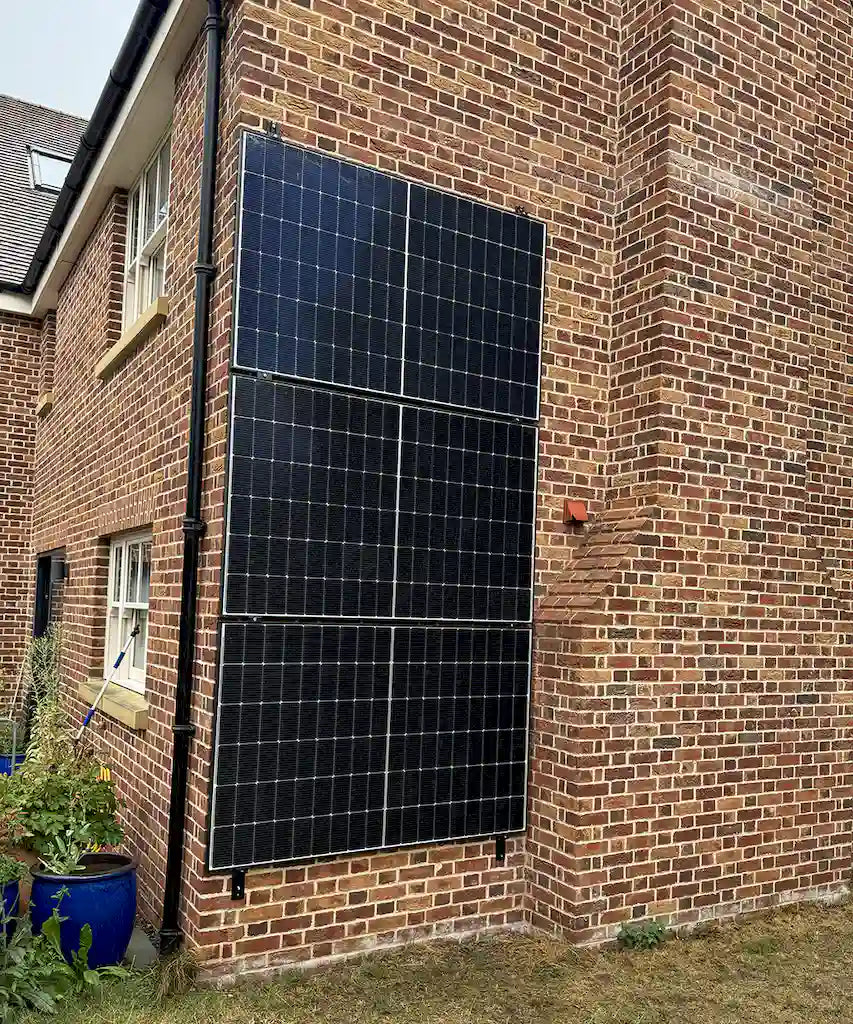
3. South-Facing House Wall
A suitable south-facing wall can turn otherwise unused vertical space into a solar-generating surface.
Vertical panels generally do not achieve the same summer peak production as optimally tilted south-facing panels, but they can still provide useful generation.
A wall installation can also perform comparatively well when the sun is lower in the sky during spring, autumn and winter.
Wall mounting can be particularly useful where gardens are small or where homeowners do not want panels occupying ground space.
4. East- or West-Facing Wall
South-facing solar is often associated with maximum annual production, but the highest total generation is not always the only objective.
An east-facing panel tends to produce more electricity earlier in the day, while a west-facing panel can remain productive later into the afternoon.
For a household that uses more electricity after returning home in the afternoon, a west-facing panel may provide useful generation during a time when demand is increasing.
5. Mesh Fence Solar Panel Mounting
Strong mesh fencing can provide an interesting location for compact solar installations.
Panels installed on a suitable fence can make use of boundary space without occupying a patio or garden area. This can be particularly useful in smaller gardens where ground space is valuable.
The fence and mounting system must be strong enough for the additional weight and wind forces created by the panels.
The orientation of the fence is also important. A heavily shaded north-facing boundary may produce considerably less electricity than an open south-, east- or west-facing fence.
6. Pergola or Garden Canopy
Pergolas can provide an excellent opportunity to combine shade and solar generation.
A strong timber or metal pergola may offer mounting positions above a patio or seating area, allowing solar panels to generate electricity without consuming additional garden space.
The structure must be assessed carefully because solar panels add both weight and substantial wind loading.
The exact mounting angle can potentially be chosen to balance appearance, solar production and the design of the pergola.
7. Garage
A detached or attached garage can provide several possible locations.
Depending on the building, panels may be suitable for a garage roof, wall or a secure mounting structure positioned beside it.
Garages can be especially useful where the main house roof is shaded or difficult to access.
Cable routing may also be relatively simple if the garage already has an electrical supply, although the exact electrical arrangement must still be suitable for the equipment being used.
8. Garden Shed or Workshop
Sheds and small workshops are another possible source of unused solar space.
A robust shed roof may provide useful exposure, particularly if the building sits in an open part of the garden.
However, many lightweight timber sheds were not designed to support additional loads or high wind forces from solar panels. The structure should therefore be suitable before any mounting system is added.
Where roof mounting is not appropriate, a nearby ground-mounted or wall-mounted arrangement may be a better option.
9. Balcony or Terrace
Balconies are widely associated with compact Plug & Play solar systems in parts of Europe because they provide useful outdoor space for people who do not have private gardens or suitable roofs.
However, balconies vary enormously in their structure, orientation and ownership arrangements.
Any installation must be secure, and homeowners or residents should consider the requirements that apply to their particular property, building, lease or landlord arrangement.
Wind exposure can be especially important at height, so a balcony installation should never rely on improvised mounting.
10. Flat Roof or Low Outbuilding Roof
A suitable flat roof can provide excellent solar exposure and allows the panels to be tilted towards a favourable direction.
Garages, extensions and other low buildings can sometimes offer easier access than the main house roof.
Ballasted systems may potentially avoid roof penetrations in appropriate installations, although roof loading, waterproofing, wind resistance and the characteristics of the building all need to be considered.
A low roof should not be treated as simply another piece of garden ground. The structure below must be capable of safely supporting the complete installation.
Which Location Is Best?
There is no single answer because every property is different.
| Location | Main Advantage | Main Point to Check |
|---|---|---|
| Garden | Excellent positioning flexibility | Shading and wind exposure |
| Patio | Ideal for ballasted systems | Space and secure ballast |
| Wall | Uses otherwise unused vertical space | Wall structure and orientation |
| Mesh fence | Uses property boundaries | Fence strength and wind loading |
| Pergola | Combines shelter and generation | Structural strength |
| Garage or shed | Keeps panels away from main house roof | Roof or wall load capacity |
| Balcony | Potential option where garden space is unavailable | Secure mounting and property requirements |
Think About Shading Before Anything Else
A beautifully mounted panel in a heavily shaded location may generate less electricity than a simpler installation receiving unobstructed sunlight.
Trees are a common issue because their effect changes throughout the year. A deciduous tree may appear relatively harmless in winter but create substantial shade once leaves return.
Buildings, fences and garden structures can also cast long shadows during mornings and evenings.
Before choosing a permanent position, observe the location at several times during the day.
Accessibility Can Be an Advantage
One benefit of garden, fence and low-wall installations is that panels remain relatively easy to reach.
This makes visual inspections easier and allows dirt, leaves, bird deposits or other debris to be dealt with safely when necessary.
Accessibility can also simplify checking mounting bolts, cables and connectors periodically.
However, panels should also be positioned where children, pets, garden machinery and normal household activities are unlikely to damage them.
What About the Microinverter?
The solar panels are only one part of the installation.
The microinverter must also be positioned according to the manufacturer's requirements. In many systems it is mounted behind or close to the solar panels.
Cable lengths should be considered before deciding where the panels will go. A location that receives excellent sunshine may be impractical if the electrical connection cannot be routed safely and appropriately.
The DC cable from each panel to the microinverter and the AC cable from the microinverter towards the intended connection both need to be considered as part of the complete design.
Can Two Panels Face Different Directions?
Potentially, yes, if the microinverter is designed appropriately.
A two-panel microinverter with two independent MPPT channels can optimise each compatible panel separately.
This can make unusual installations more practical. One panel could potentially face east and the other west, allowing generation to be spread across a greater part of the day.
The panels must still remain electrically compatible with the microinverter.
Do Panels Always Need to Be Tilted?
No. Vertical panels can still generate useful electricity.
Tilting a panel towards the sun can improve annual production, but vertical mounting may be preferable where space is limited or where a wall or fence provides the most practical installation surface.
Vertical panels can also receive less dirt accumulation and may perform relatively well during periods when the sun is lower in the sky.
The right choice depends on the property and what the homeowner is trying to achieve.
Safety and Mounting Matter
Solar panels are large objects exposed to wind, rain and changing weather conditions.
Even a relatively compact panel can create significant wind forces, particularly when mounted at an angle or above ground level.
The mounting solution should therefore be designed for the application rather than improvised from unsuitable brackets or temporary fixings.
Before choosing a location, consider:
- How much direct sunlight the area receives
- Morning and afternoon shading
- The orientation of the panel
- Whether a tilt is practical
- Wind exposure
- Structural strength of the wall, fence, roof or pergola
- Panel and mounting-system weight
- Safe cable routing
- Distance to the intended electrical connection
- Access for inspection and cleaning
- Whether the location interferes with normal garden or household use
- Any planning, leasehold, landlord or property restrictions that may apply
A Practical Example
Imagine a homeowner has a roof that faces an inconvenient direction and is partly shaded by mature trees.
The rear garden, however, receives strong sunlight from late morning until evening.
Instead of installing panels on the roof, the homeowner could consider two compatible solar panels on secure ballasted garden mounts. The panels could be positioned where shading is limited and tilted towards a favourable direction.
Another homeowner may have almost no suitable ground space but a strong south-facing mesh fence. A secure fence mounting system could potentially turn that unused boundary into a small solar-generating area.
A third property may have a west-facing garage wall. Although annual generation might be lower than from an ideal south-facing tilted array, the system could produce more electricity during the afternoon when the household is beginning to use more power.
This flexibility is one of the main attractions of Plug & Play solar.
Conclusion
Plug & Play solar panels can potentially be installed in many different locations around a UK home. Gardens, patios, walls, mesh fences, pergolas, garages, sheds, balconies and suitable flat roofs can all provide opportunities depending on the property.
Garden installations are particularly flexible because suitable ballasted mounting systems can position panels where solar exposure is favourable without necessarily requiring permanent ground fixings.
Walls and fences can make use of otherwise unused vertical space, while east- and west-facing installations can spread generation across different parts of the day.
The best location is not simply the sunniest place visible at midday. Homeowners should consider shading throughout the day, panel orientation, structural strength, wind loading, cable routing, accessibility and the requirements that apply to the property.
A small solar system will produce the best practical results when the location, mounting system, panels and microinverter are considered together rather than as separate products.
The ability to use unconventional spaces is what makes Plug & Play solar particularly interesting. A property that appears unsuitable for traditional rooftop solar may still contain several practical locations where a compact system could generate useful renewable electricity.
Explore Plug & Play Solar Mounting Options
Worldwide Solar supplies products for compact home solar installations, including Plug & Play microinverters and mounting solutions designed for gardens, walls, mesh fences and other suitable locations.
Visit Worldwide Solar to explore practical solar products for creating a system that suits the available space around your home.